AC charging is a separate comparison
For AC charging, check the vehicle’s onboard charger, the available phases and the charging equipment. A three-phase-capable connector does not mean every car or site will charge at a three-phase rate.
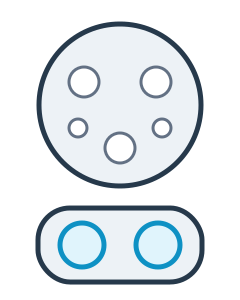
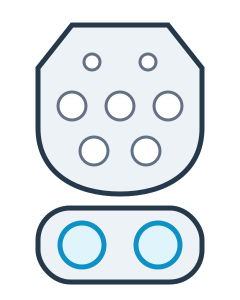
CCS1 (Combo 1) and CCS2 (Combo 2) are two vehicle connector designs within the Combined Charging System. CCS1 uses a Type 1 upper section; CCS2 uses a Type 2 upper section.
Both add two lower contacts for DC charging, but their plugs and vehicle inlets are not directly interchangeable.
Combo 1
Combo 2
The difference begins with the upper AC connector design. For a purchase decision, also check the vehicle inlet, charging method and the exact charger configuration.
| Comparison point | CCS1 / Combo 1 | CCS2 / Combo 2 |
|---|---|---|
| Upper connector design | Type 1 / SAE J1772 | Type 2 |
| Lower DC contacts | Two additional DC contacts | Two additional DC contacts |
| AC connection at the vehicle | Type 1; single-phase design | Type 2; single- or three-phase capability, subject to vehicle and site |
| DC charging | Supported by the Combo 1 system | Supported by the Combo 2 system |
| Regional context | Associated with North American CCS vehicles; check the actual inlet | Main CCS configuration for Europe; check the actual inlet |
| Direct plug interchange | A CCS1 plug does not directly fit a CCS2 inlet | A CCS2 plug does not directly fit a CCS1 inlet |
A connector name does not specify a charger’s voltage, current, cooling design or the power a vehicle will accept. Check the rated hardware and vehicle documents for the exact project.
How charging power is determinedNot by connector name alone. The Type 2 section associated with CCS2 can support three-phase AC charging where the vehicle and site allow it. DC charging power depends on the specific vehicle, charger, cable assembly and operating conditions for either Combo design.
For AC charging, check the vehicle’s onboard charger, the available phases and the charging equipment. A three-phase-capable connector does not mean every car or site will charge at a three-phase rate.
For DC charging, compare the vehicle’s permitted voltage and current with the charger and cable ratings. Actual power can change during a session, including with battery state of charge and temperature.
Ask for the exact datasheet and test conditions before comparing kW figures.
Send your project requirementsFor a German or wider EU project, begin with the vehicles that will use the site and the applicable rules for the charging point. Combo 2 is the key CCS connector in the European interoperability framework. North American vehicles may have Combo 1 or another inlet, so do not select hardware from country of manufacture alone.
Record each vehicle’s model year, original sales market and inlet type. A clear photo of the open charge port can resolve uncertainty.
State AC or DC charging, dwell time, target power and simultaneous vehicle count.
Provide the installation country, grid input and whether the point is public. Confirm current local requirements with the project team.
Compare the proposed charger model, connector, cable, documents and testing scope before ordering.
A CCS1 plug and a CCS2 vehicle inlet do not connect directly, and the reverse is also true. Some projects assess purpose-built adapters, but suitability depends on the direction of connection, AC or DC use, the rated voltage and current, vehicle and charger compatibility, local requirements and the adapter manufacturer’s instructions.
Ask About a Cross-Region ProjectAssess a CCS2-to-CCS1 adapter for the exact vehicle and station.
Assess the reverse direction separately.
These are connection directions, not a product recommendation or a compatibility guarantee.
Connector selection is one part of a charging project. Share your target market, vehicles and site conditions so the proposed charger and documents can be checked as one configuration.
For projects comparing smaller DC charging formats. Ask which connector and market configuration is available for your fleet.
Request Product DetailsFor commercial DC sites that need a project-specific review of vehicles, power and connector arrangement.
Request Product DetailsNeed a model datasheet? Tell us the market and configuration you are evaluating.
Request Product DetailsClear answers for the next step in your charging project.
No. Type 2 names the AC connector design in the upper section. CCS2, also called Combo 2, includes that section and two additional lower contacts used for DC charging.
Neither connector name guarantees a higher DC charging rate. Check the exact vehicle, charger, cable and operating limits. For a European project, also check the applicable connector requirements and the vehicles that will use the site.
The plugs do not connect directly. A purpose-built adapter may be assessed for a specific vehicle and station, subject to its rated use, manufacturer instructions and local requirements. Do not assume every adapter or charging network will work.
CCS1 remains relevant to vehicles and stations that use it. SAE J3400/NACS is also part of the North American market. Check the actual vehicle inlet and charging network before specifying a new installation.
Send the installation country, vehicle make and model year, original sales market, a photo or specification of each inlet, the AC or DC charging task, site power conditions and the number of vehicles to charge at once.