 Residential
 Workplace
 Commercial
 Retail & Hospitality
 EV Chargers
 EV Adapter
 EV Accessories
 Home Charging
 Business charging
 Fast charging
Overnight guests
Start by evaluating AC charging for longer parking stays. Confirm how much energy guests need and the time their vehicles will remain connected.

FOR HOTEL OWNERS AND PROJECT CONTRACTORS
Choose charging equipment around how your guests park, the power your property can provide, and the way you plan to manage access and payment.
EV-TOP manufactures AC and DC charging equipment for hotel and resort projects, with configuration review, technical documentation and remote support for your local project team.
Equipment selection starts with your location, parking duration, charging point count and available power.
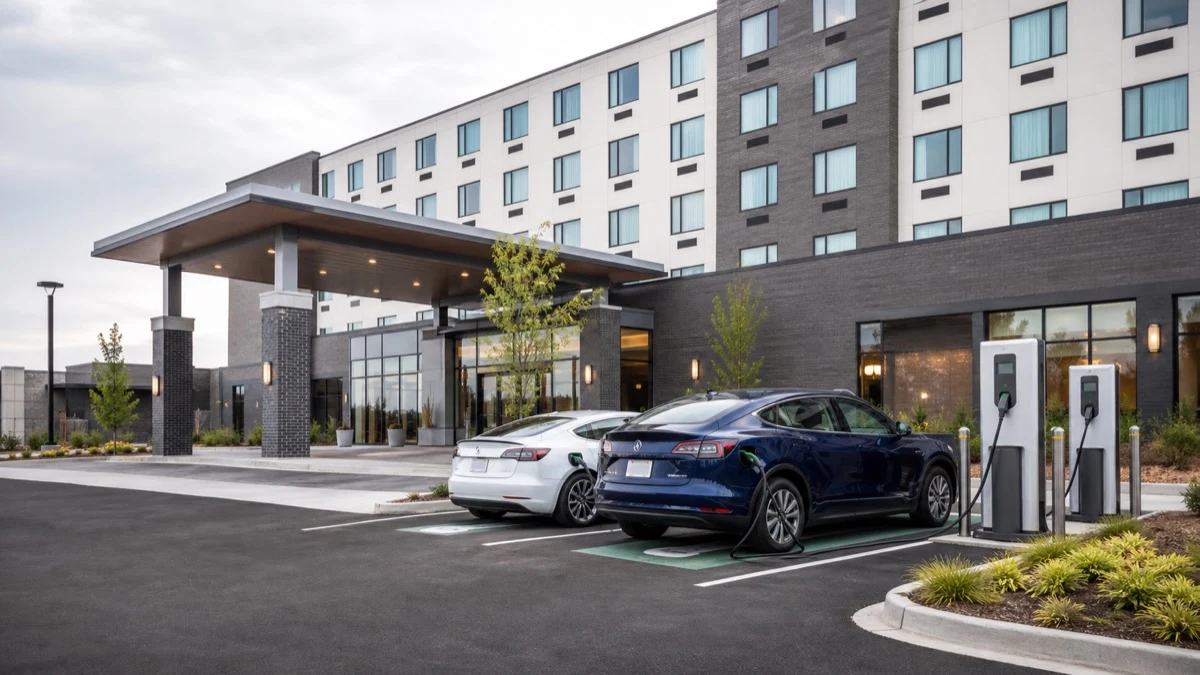
A hotel can serve several charging needs in the same car park. Separate them before choosing the equipment.
Start by evaluating AC charging for longer parking stays. Confirm how much energy guests need and the time their vehicles will remain connected.
Use expected dwell time and vehicle turnover to compare AC with DC charging. A shorter visit does not automatically require the highest power available.
Plan access and parking areas around staff shifts and vehicle schedules. Shuttle charging needs a separate review of vehicle compatibility and daily energy demand.
Consider DC charging where a defined short-stay service is part of the business plan. Review traffic demand, site capacity and the operating model first.
Room count is useful context. Charging demand depends on how many vehicles need energy at the same time.
Compare the charging task first. We then review the model, connector, installation arrangement and required functions for your market.
Charging power is not a guaranteed charging speed. The vehicle, battery conditions, available site power and session settings all affect the energy delivered.
Planning a highway-facing hotel with higher charging demand? Include the expected traffic and target stop duration so we can assess whether a higher-power DC option is appropriate.
Agree who can use the charging spaces, who operates the service and how payment will be handled. These choices guide the hardware and software review.
Define the eligible guest group, how access is issued and when charging spaces should be released. Your hotel still needs clear instructions and a contact for charging issues.
Choose the operator and billing workflow before ordering. Review metering, price display, payment handling and the records needed for the project’s local requirements.
Review access rules and opening hours with your local project team. Public access can bring additional registration, payment and operating requirements.
Charging shares the site with kitchens, heating, cooling and other hotel loads. Review available electrical capacity and the busiest operating periods before setting the number and power of charging points.
Ask your local electrical team to confirm the supply, existing peak demand and the power that can be allocated to charging.
A compatible load management setup can adjust charging within an agreed site limit. The controller, metering, communications and fallback behaviour need to be checked together.
Allow for future parking spaces, cable routes, distribution capacity and maintenance access. Add charging points when the site design and operating data support the next step.
Load management cannot create additional supply capacity. An electrical upgrade may still be needed to meet your charging target.
Learn About Load ManagementA workable hotel charging project needs clear responsibilities from procurement through daily operation.
| Responsible party | Scope to confirm |
|---|---|
| EV-TOP | Charging equipment, agreed configuration, product and installation documentation, factory testing, spare-parts arrangements and remote technical support. |
| Local contractor or installer | Site survey, electrical design, permissions, civil works, installation, grid coordination, commissioning and on-site fault investigation. |
| Hotel or appointed charging operator | Guest instructions, access policy, pricing, parking rules, billing, daily operation and the first contact for guests. |
| Charging platform or integration provider | Platform accounts, agreed software functions, payment and PMS interfaces, ongoing service and system-specific testing. |
Tell us the project country, charging point count, mounting requirements, power supply and intended operating model. We can then identify the applicable product information and documents for the configuration under review.
Request Technical InformationAC is a useful starting point for overnight guest and staff parking. DC may suit shorter visits or a defined fast-charging service. The choice depends on parking duration, energy demand, vehicle capability and the electrical capacity available at the property.
Start with the number of vehicles expected to need charging at the same time, their parking duration and the energy they need. Include staff and hotel vehicles separately. Room count alone does not determine the right number of charging points.
Guest access can be planned as part of the project. Confirm how guests will be identified, how access will be issued and which equipment and platform functions are required. In Germany, the actual access arrangements determine whether charging is publicly accessible; private land alone does not decide this.
This requires a project-specific review. Share your PMS, version, billing workflow and charging platform. The interfaces, metering requirements, data permissions and acceptance tests must be agreed before room billing can be included in the delivery scope.
Load management can help allocate the capacity already available. It cannot guarantee that an upgrade will be unnecessary. Your electrical team should review site demand and the charging target, then confirm the selected control and metering arrangement.
Equipment, charging point count, mounting, cabling, electrical work, metering, software and payment services all affect the total cost. EV-TOP quotes the agreed equipment scope. Local installation and ongoing operating costs should be confirmed with the responsible providers.
Our standard bulk-order MOQ is 100 units. Samples, testing and selected project orders can be reviewed as exceptions. Share the initial quantity and any wider rollout plan so we can assess the appropriate supply arrangement.
Your local contractor or installer handles site work and initial on-site checks. EV-TOP provides product documentation, remote technical support and agreed spare-parts support. Standard remote support is 5 × 8; local attendance and service-level commitments require separate agreement.
The standard warranty is 24 months from the EV-TOP shipment or bill-of-lading date. Warranty parts follow remote diagnosis of a product quality issue; local labour, removal, reinstallation and logistics follow the contract. Standard configured hardware is normally scheduled for about one month after the purchase order, 50% deposit and written configuration approval. Software, certification and non-standard work require separate schedules.
Share the location, planned charging point count and typical parking duration. Add any details you already have about available power, access, payment and your target opening date.
If the electrical capacity or operating model is still being decided, tell us that too.
Discuss Your Hotel ProjectWe will review the equipment requirements and the information needed for the next step.